If you’ve checked GPU prices lately and felt your stomach drop, you’re not imagining things. Why are GPU prices so high in 2026? The short version: a memory shortage, an AI buying spree, and higher chip and board costs have hit at the same time. That’s a rough combination for anyone who just wants to build a PC without taking out a loan.
This isn’t a repeat of the crypto-mining shortage from a few years back, even though it feels familiar. The causes are different this time, and so is what you should actually do about it.
The Short Answer: What’s Actually Driving GPU Prices Up
Four things are stacking on top of each other right now (the first two matter most):
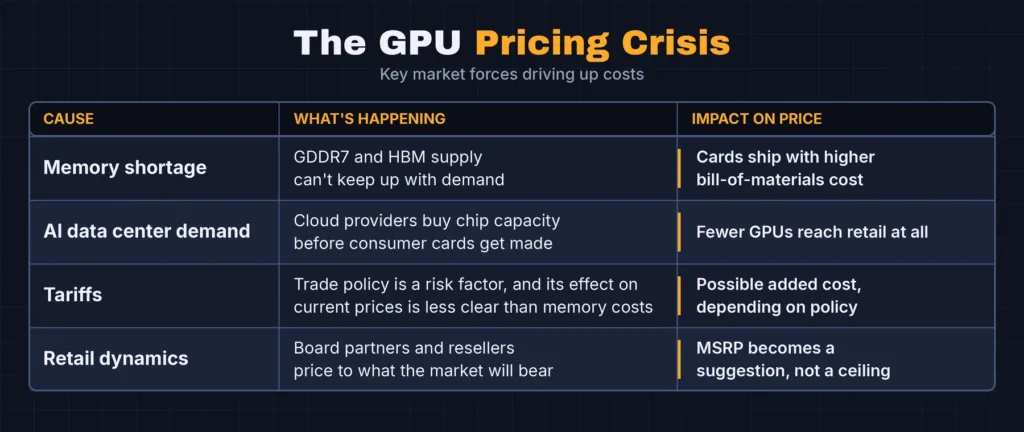
None of these alone would cause a crisis. Together, they’ve pushed prices up across nearly every price tier — not just the high end.
Cause 1: Memory Chip Shortages Are Squeezing GPU Supply
VRAM is the memory that sits directly on a graphics card, and it’s become the tightest link in the chain. Memory is one of the two biggest reasons GPU prices are climbing in 2026.
Why GDDR7 and HBM Are in Short Supply
GDDR7 is the memory standard powering most current-gen consumer cards, and HBM (high-bandwidth memory) is what data-center accelerators use. Both draw from the same limited pool of memory fabs. When AI accelerator demand spikes, memory manufacturers shift production toward the higher-margin HBM contracts. That leaves less GDDR7 capacity for consumer GPUs — and less capacity means higher prices for what’s left.
How Memory Costs Flow Into Card Pricing
Memory is a large part of what a card costs to build, and the price of it has been climbing fast. TrendForce expected conventional DRAM contract prices to rise another 58-63% in the second quarter of 2026 alone. NVIDIA also sells its GPU and memory to board partners as a bundled kit, so when memory costs rise, the kit price rises, and the cost reaches the shelf.
Cause 2: AI Data Centers Are Pushing GPU Prices Up
Wafer Allocation and Foundry Priority
Every chip — consumer GPU or AI accelerator — starts as silicon cut from a wafer at a foundry. Foundries allocate wafer capacity based on who’s paying the most and ordering the largest volumes. AI accelerator orders from major cloud providers are enormous and locked in years ahead. Consumer GPU orders, by comparison, are smaller and more price-sensitive. When capacity is tight, foundries prioritize the contracts that protect their margins.
Why Consumer GPUs Lose the Bidding War
This is the part that’s honestly a little frustrating for anyone building a gaming PC: consumer graphics cards are no longer the most profitable thing a chipmaker can produce with a given wafer. That’s the blunt truth of it. As long as AI infrastructure spending keeps climbing, consumer GPUs will keep getting squeezed for capacity, not because manufacturers dislike gamers, but because the math doesn’t favor them right now.
Cause 3: Tariffs and Trade Policy Are a Wild Card
Tariffs are the least certain piece. Trade policy on chips and finished electronics has been in flux, and any new duty on cards or components would show up at the checkout quickly. So far, though, memory and wafer costs explain more of the 2026 increases than tariffs do. Check current policy before you buy.
Cause 4: Retailers and Scalpers Inflate GPU Prices Further
Retail markups push GPU prices in 2026 even higher than the chips alone would justify. MSRP — the manufacturer’s suggested retail price — has become mostly aspirational. Board partners (the companies that build and sell cards using a chip maker’s GPU) set their own prices, and when supply is tight, they price toward what buyers will actually pay, not the number printed in a press release. Add resellers and scalpers buying limited stock to flip at a markup, and the gap between “sticker price” and “what you’ll actually pay” widens fast.
Is This Like the 2020–2021 Shortage? What’s Different This Time
Short answer : no, and that distinction matters for how you plan around it.
The 2020–2021 shortage was driven by crypto-mining demand — a use case that could evaporate overnight if coin prices crashed, which is roughly what happened. AI infrastructure demand doesn’t work that way. Cloud providers are signing multi-year capacity contracts, building physical data centers, and treating chip supply as a long-term strategic resource. That demand isn’t going away soon” (nobody can promise a product cycle).
What to Do While GPU Prices Stay High in 2026
If You Need a GPU Immediately
- Buy from an authorized retailer, not a marketplace reseller — the markup on third-party listings is usually the worst of it.
- Consider the previous generation, but compare prices first: some older cards are also selling well above their original MSRP.
- Check regional pricing if you have flexibility — tariff impact isn’t uniform everywhere.
If You Can Wait
- Set a price alert and give it 3-6 months. Foundry capacity does expand, just slowly.
- Watch for a generational refresh announcement — outgoing-generation stock often gets discounted to clear inventory even during a shortage.
Alternatives Worth Considering
- Used market: A well-vetted used GPU from a reputable seller can cost significantly less than new stock, though warranty coverage is a real trade-off.
- Cloud gaming: For buyers who mainly want to play, not build, a subscription service sidesteps the hardware market entirely.
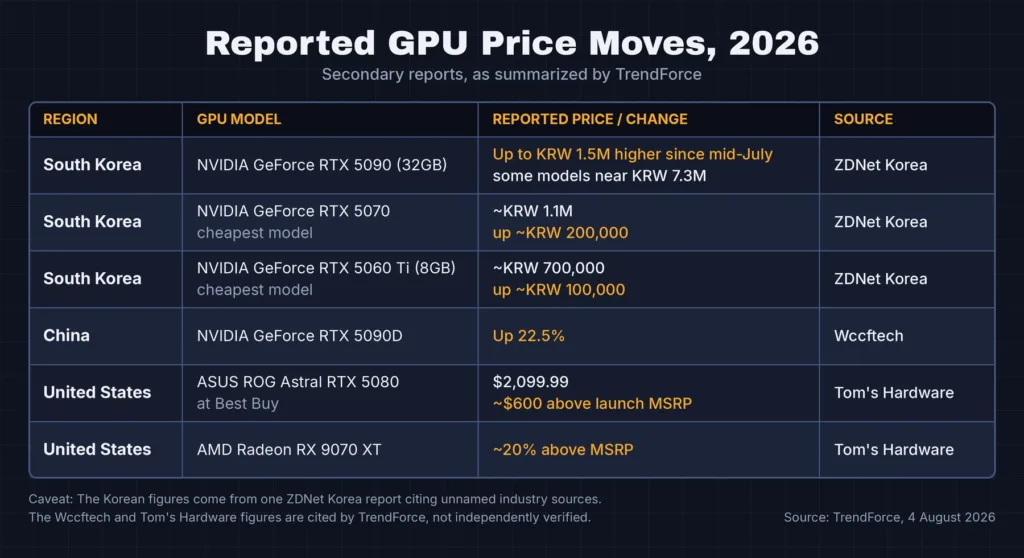
- Lower-tier cards: Prices have risen somewhat less in percentage terms in the Korean data we checked, but they have still gone up.
When Will GPU Prices Come Down?
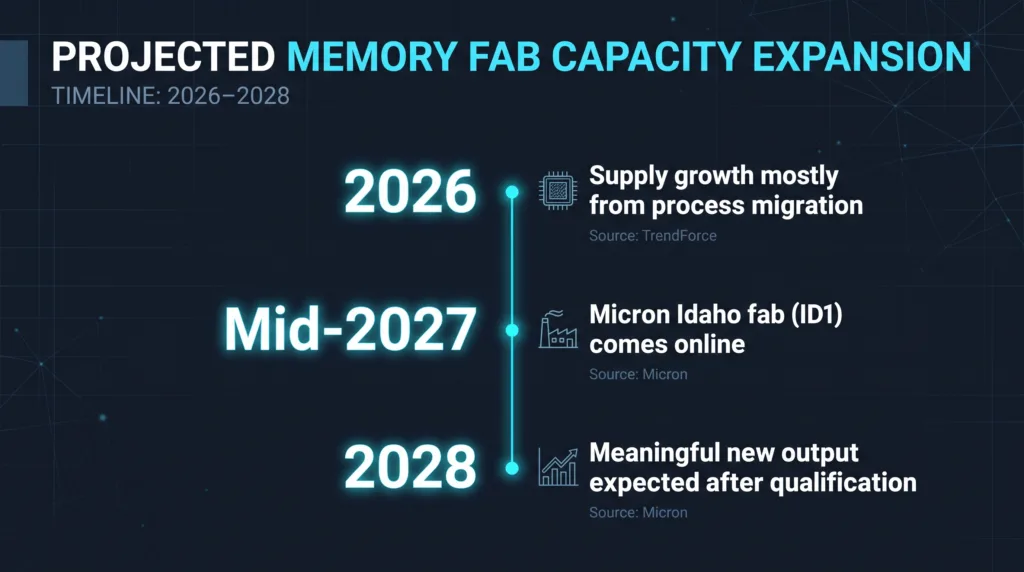
Probably not soon. DRAM makers are adding capacity mainly through process upgrades this year, because new factory floors take time to build. Micron has said its new Idaho fab comes online in mid-2027, with meaningful output only after qualification, around 2028. Early output from new fabs may also go first to back-orders, so consumer relief could lag even then. Tariff policy could change faster, but that is a political question and hard to forecast. The realistic expectation is high prices through at least 2027, not a sudden drop back to old MSRPs.
Frequently Asked Questions
Why are GPU prices going up in 2026?
Mainly memory shortages as chip makers favor AI server demand, plus higher wafer and bundle costs. Retail markups and trade policy add to it.
Will GPU prices go down in 2026?
Unlikely. Memory supply is expected to stay tight through 2027, and new capacity mostly arrives from mid-2027 into 2028.
Is it a good time to buy a GPU right now?
Only if you need one. If your current card still handles what you need, waiting is the more cost-effective move.
Why is VRAM so expensive right now?
Memory manufacturers are prioritizing high-bandwidth memory contracts for AI accelerators over consumer-card memory production, tightening supply.
