Imagine your childhood favorite game feeling new again on your modern device. Retro gaming features are more than just old-school relics. They are the pulse of a growing revival.
Features like pixel-perfect visuals and chiptune soundtracks keep players coming back for more. The GOG Preservation Program shows this: 26 classic titles, including Silent Hill 4: The Room, now work great on today’s tech.
With discounts up to 89% on games like Tomb Raider: Underworld, it’s easy to go back to gaming’s golden age. But why do these old-school aspects still captivate us? Let’s explore the timeless magic that connects old-school fun with modern play.
Key Takeaways
- GOG’s program ensures 100+ retro games stay playable with tech support and offline options.
- Titles like Silent Hill 4 now include hidden content never seen on PC before.
- Modern discounts let players relive classics at prices as low as 35% off.
- Retro gaming features like pixel art and chiptune music inspire indie games today.
- Emulators and cloud services make nostalgic gaming aspects accessible on devices like Chromebooks.
The Enduring Appeal of Classic Gaming Elements
Pixel art and simple controls still draw us in today. It’s not just nostalgia. Vintage games show how creativity blooms under constraints. Let’s see why old-school gaming remains relevant in today’s tech.
Why Nostalgia Drives the Retro Gaming Renaissance
Our love for retro games comes from childhood memories. Playing classics like Mario Bros feels like going back to simpler times. Nostalgia isn’t just a feeling—it’s a market force.
Services like Nintendo Switch Online let us relive these moments. This shows classic gaming elements are more than just old stuff. They’re a living tradition.
The Timeless Quality of Vintage Game Design
Old-school games had limited colors, making designers focus on gameplay. Games like Pac-Man used sound and mechanics to add depth. This approach still inspires games like Celeste or Shovel Knight.
| Classic Element | Modern Adaptation |
|---|---|
| 8-bit soundtracks | Chiptune remixes in indie games |
| Single-screen design | Mobile puzzle games like Monument Valley |
How Old-School Gaming Continues to Influence Modern Titles
- Modern games like Hyper Light Drifter blend retro visuals with 3D environments
- AAA titles like Starfield use pixel art menus to honor gaming history
- Indie developers use vintage game characteristics to stand out in crowded markets
From the Nothing Fold’s transparent design to the CubeSense controller’s nostalgic color scheme, brands today mix retro aesthetics with cutting-edge tech. By embracing old-school gaming attributes, they honor the past while pushing innovation forward.
Iconic Retro Gaming Features That Defined an Era
I’ve always been amazed by how retro gaming features turned limitations into art. From 8-bit sprites to simple controls, these features weren’t just technical workarounds. They became the heart of gaming. Let’s explore what made classics like Super Mario Bros. and Metroid so memorable.
- Pixel-perfect visuals: Every pixel had a story, from the jagged 8-bit characters to the dynamic worlds.
- Chiptune soundtracks: Simple beeps and boops became iconic, like the Legend of Zelda theme that still sends shivers down our spines.
- Simple controllers: With just a D-pad and two buttons, games like Street Fighter II became tests of skill.
- Challenge-driven design
These elements created games that felt close and achievable. Even today, games like Hollow Knight draw from this legacy. Retro gaming features showed us that innovation can bloom under tight constraints. The next parts will show how these traditions evolved into today’s classics.
We’re here to celebrate the lasting impact of these foundational elements. Whether you’re playing old cartridges or enjoying chiptune remakes, these features remind us why gaming feels like coming home.
Pixel Art: The Visual Language of Classic Video Games
Pixel art was more than a style; it was a must. Early systems like the NES and SNES turned technical limits into creative wins. Retro video game mechanics used precise pixel placement to show action, emotion, and settings. This visual language became a key part of vintage game characteristics, changing how players interacted with digital worlds.
The Evolution of 8-Bit and 16-Bit Graphics
From 8-bit’s blocky figures to 16-bit’s smoother looks, developers pushed the limits. Look at the NES’s The Legend of Zelda (1986) and SNES’s Super Mario World (1990). Each step forward in tech made artists find new ways to work within tight resolutions like 256×240 pixels. These limits led to iconic sprites and backgrounds that still inspire today.
How Limited Color Palettes Sparked Creative Solutions
Early systems had only 256 colors, so artists used tricks like dithering and color cycling to create depth. Games like Mega Man and Castlevania turned technical challenges into artistic strengths. Even now, indie games like Night in the Woods pay homage to this heritage, mixing old-school looks with new stories.
The Modern Pixel Art Revival in Indie Games
- Dragon Quest 11’s HD-2D mode merges 3D motion with 2D visuals, bridging eras
- Games like Kentucky Route Zero use pixel art to evoke emotional immersion
- Platforms like Itch.io celebrate pixel art as a legitimate medium, not just nostalgia
Pixel art’s comeback shows that vintage game characteristics are timeless, not just old. Whether in retro remakes or new indie games, the pixel stands as a symbol of creativity under limits.
Chiptune Music and Sound Effects: The Soundtrack of Nostalgia
Imagine starting a retro console and hearing that *plink* of a power-up. Or the pulsing bassline of a nostalgic gaming aspect. These sounds are more than memories. Early systems like the NES and Sega Genesis had antique gaming functionalities that limited composers to just a few sound channels. Yet, from these constraints came magic.
Koji Kondo turned eight-bit tones into the Super Mario Bros. theme. This melody is so familiar, it needs no introduction.
Sound designers like Yuzo Koshiro (Streets of Rage) used rhythmic blips and booms to build tension. With no room for layered orchestras, every note had to tell a story. Even sound effects—like the *boing* of a jump or the *vroom* of a racing game—became part of the gameplay experience. These audio choices weren’t just technical workarounds; they became part of gaming’s DNA.
Today, chiptune isn’t stuck in the past. Indie games like *Hyper Light Drifter* and *Ape Out* reimagine these sounds with modern twists. Festivals like the Blip Festival celebrate this legacy, proving that 8-bit music still pulses with energy. The nostalgic gaming aspects of yesteryear now inspire festivals, remixes, and streaming channels. What began as a technical hurdle became a universal language—proof that creativity thrives in boundaries.
Next time you hear a retro soundtrack, think of the ingenuity behind it. Those beeps and boops aren’t just relics; they’re the heartbeats of a genre that refuses to fade. We still play, remix, and celebrate them because they remind us why we fell in love with games in the first place.
Game-Changing Control Systems from the Golden Age
Old-school gaming wasn’t just about looks—it was about how we played. Early control systems laid the groundwork for every button press and movement. This shift from arcades to home consoles made lasting game design principles.
From Joysticks to D-Pads: The Evolution of Input Devices
- Arcade joysticks were replaced by NES D-pads for precise movement.
- Sega Genesis introduced six-button layouts for complex action games.
- Modern Switch Joy-Cons bring back this legacy with hybrid controls.
How Control Limitations Shaped Game Design
Games like Super Mario Bros. used only two buttons and a D-pad. This simplicity led to games that relied on rhythm and spatial thinking. Designers had to make every button count.
The Return of Arcade-Style Controllers
Today, indie devs and retro fans are bringing back arcade sticks and button-heavy pads. These controllers offer a feel that modern screens can’t match. Even big games like Street Fighter V prefer the classic layouts.
Controls are key to the player-game connection. The simplicity of old-school gaming shows that innovation comes from limits. As we move forward, these classic mechanics still influence how we play, showing the past’s lasting impact.
Level Design Philosophies That Stand the Test of Time
Classic gaming elements like intuitive level design show that simplicity can last longer than trends. Features from the 80s and 90s still shape how we create challenges today. Let’s explore why these ideas are still important.
Elegant Simplicity in Stage Design
Games like Super Mario Bros. had stages with clear paths and visual hints. Each screen taught players how to move forward without text. This made it easy for new players to understand their goals.
Think of Zelda dungeons: their symmetry and item placement help guide exploration. This makes it easy to find your way.
Spatial Puzzles Without Complexity
- Metroid’s connected areas made players revisit zones with new skills.
- Prince of Persia traps used physics and light/shadow to solve them.
- These puzzles relied on observation, not just memorization, making them timeless.
Memory Challenges as Core Mechanics
Games like Castlevania: Symphony of the Night needed players to remember enemy patterns and layouts. This created a cycle of learning and success. Modern games like Hollow Knight mix memory-based combat with exploration.
Traditional gaming features remind us that great design focuses on player engagement, not just new mechanics. Whether it’s mapping a maze or timing a jump, these ideas keep retro games exciting for decades.
Traditional Gaming Features That Created True Challenge
Ever played a game where one wrong move sent you back to the start? Features like limited lives and permadeath were more than just technical limits. They were design choices that made every action a high-stakes moment. These features forced players to learn patterns, master reflexes, and embrace retry loops.
Let’s break down how these systems worked:
- Limited Lives: Games like Pac-Man
- No Auto-Saves: Progress depended on beating full levels (think Mega Man stages).
- Permadeath: Losing a character in Dragon Quest meant starting over entirely.
These systems demanded focus. Every coin collectedible or hidden path became a survival strategy. Modern games like Dark Souls borrow this tension, balancing frustration with satisfying mastery. But how did this shift from “Nintendo Hard” to today’s save-anywhere games happen?
| Traditional Feature | Modern Equivalent | Player Impact |
|---|---|---|
| Limited Lives | Checkpoint systems | Encouraged pattern learning vs. risk mitigation |
| No Auto-Saves | Cloud saves + quickload | Built tension around progress milestones |
| Permadeath | Roguelike respawns | Forced strategic thinking |
Antique gaming functionalities prioritized skill over convenience. While modern titles often streamline difficulty, the best retro-inspired games still use these mechanics to create memorable challenges. We’re reminded that fair difficulty isn’t about cruelty—it’s about making every victory feel earned.
The Social Experience of Retro Gaming
Retro games created connections in unique ways, unlike today’s online games. They used leaderboards and shared controllers to bring people together. Living rooms and arcades became places of friendship and fun.
Arcade Culture and Competitive Leaderboards
Picture a busy arcade where every coin could win you the top score. Leaderboards were real, shining bright in neon lights. Seeing your initials on the screen was a big deal.
These places turned strangers into friends and rivals. They were the start of something special.
The Birth of Couch Co-op and Versus Play
- Super Mario Bros. needed teamwork to beat levels.
- Street Fighter II made living rooms battlegrounds.
- Local multiplayer was the first social media.
Limited Save Functions as Social Glue
Games like Legend of Zelda made friends necessary for progress. No cloud saves meant everyone had to work together.
“We’d all gather around one TV, passing the controller,”
remembers a community member. Emulators like RetroArch let us relive these moments. But the real magic was in the room.
Today, indie games mix old-school charm with new tech. They show us that true connection starts with a shared screen.
Hardware Limitations as Creative Catalysts
Early game developers turned hardware limits into creative strengths. The old-school gaming attributes we love today, like Link’s sword flicker in The Legend of Zelda, came from clever workarounds. They used sprite prioritization to add depth to simple systems, showing that creativity blooms under pressure.
The Super Nintendo’s Super FX chip allowed Star Fox to show 3D graphics on 16-bit hardware. Engineers also used procedural generation in games like Elite. They coded algorithms to create galaxies instead of storing data. These retro gaming features were not weaknesses; they were creative solutions.
- Sprite flickering became a gameplay mechanic in Metroid to save processing power
- Palette cycling tricked eyes into seeing color variety on 8-bit systems
- Memory constraints forced concise storytelling, like Maniac Mansion’s text-heavy adventures
Today, indie devs aim to recreate these limitations. Games like Return of the Obra Dinn use monochrome visuals for a retro feel. Tools like NVIDIA’s Project DIGITS, made for AI, show how modern tech can learn from the past. The key takeaway? Constraints are not obstacles; they are opportunities for innovation.
Collecting and Preserving Antique Gaming Functionalities
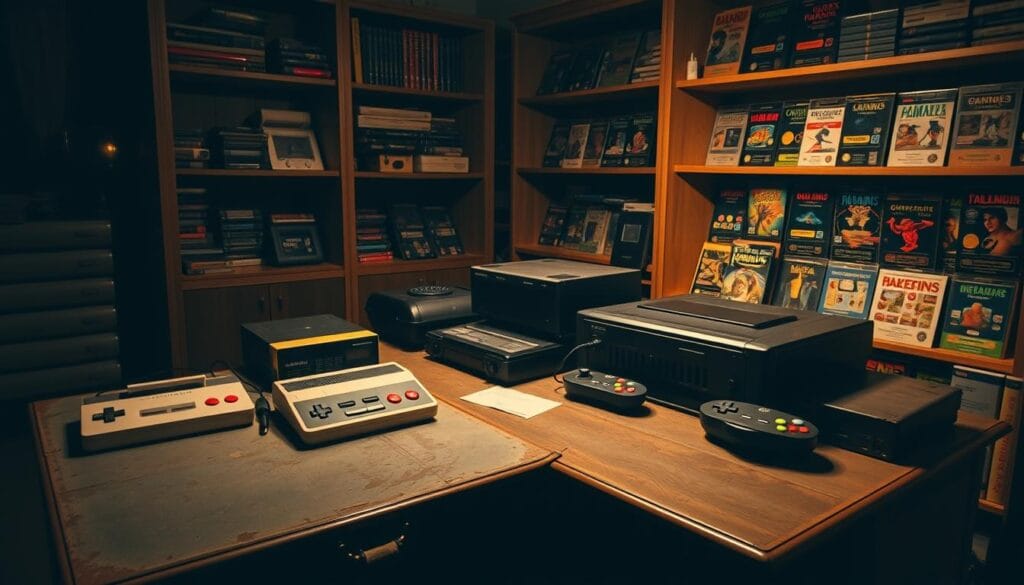
Keeping retro gaming alive is a mix of love for the past and keeping things working. Fans cherish original items like Nintendo cartridges or Sega Genesis consoles. They see these as pieces of gaming history. But, to make them work with today’s screens, they might need updates like HDMI upscalers or flash carts.
Here’s how collectors keep these treasures safe:
- Hardware preservation: Repair shops now specialize in restoring antique gaming functionalities, using non-invasive methods to extend console lifespans.
- Digital archives: Museums like The Strong National Museum of Play partner with developers to scan and document retro video game mechanics, ensuring code survives physical decay.
Legal issues come up when we talk about emulation. The Nothing Fold’s design looks like old-school games. Emulation platforms like RetroArch remind us:
“Always own the original game before using ROMs.”
Users must show they own the game physically when using emulators.
Projects like the Internet Archive’s public domain game collections show how we can preserve games ethically. By using official emulation tools and respecting copyright, we celebrate creators and keep retro gaming alive.
How Modern Games Incorporate Nostalgic Gaming Aspects
Retro-inspired gameplay is more than a trend. It’s a key design choice in today’s games. Developers mix nostalgic gaming aspects with new tech for exciting experiences. Games like Shovel Knight and Stardew Valley show how classic gaming elements still captivate players who love simplicity and charm.
Games such as Mega Man 11 and Sonic Mania find a perfect balance. They keep pixel art and precise controls but add HD graphics and online leaderboards. Even big games like Atomfall (out March 27, 2025) combine British icons with open-world adventures. This mix respects the past while exploring new grounds.
- Zupee updates traditional games like Ludo with real-money prizes, blending old charm with new tech.
- Atomfall uses a first-person view and melee combat, merging old looks with modern gameplay.
- Indie hits like Hollow Knight take inspiration from Zelda but make games more accessible to everyone.
The secret to success is being true to the past. Just using old visuals isn’t enough. Games must capture the essence of what made classics great. When done well, this mix connects players to their gaming roots while feeling new. The best games show that nostalgia is more than a trick—it’s a source of creativity.
Conclusion: Why Retro Gaming Features Continue to Captivate Players
Retro gaming features are still loved because they focus on fun and creativity. Chromebook gaming shows us that enjoyment comes from simple, classic designs. Pixel art and chiptune soundtracks show that timeless appeal is in the gameplay, not just the looks.
Games like The Baron Upright and Bao Zhu Zhao Fu mix old-school charm with new ideas. The Baron Upright has dual 4K screens, paying homage to arcade days. Bao Zhu Zhao Fu introduces new jackpot systems, showing how to keep the old spirit alive with innovation. Players love these games because they offer both nostalgia and new twists.
Getting into retro gaming is now easier than ever. You can play through emulation, modern ports, or refurbished hardware. As AI and cloud tech improve, we’ll see even more ways to enjoy these classics. The joy of a great level or catchy tune never gets old. The future of gaming still finds magic in the past.