Are you feeling lost in the sea of VR and AR options? Or maybe your current gear isn’t meeting your expectations?
Our vr/ar buying guides offer clear, actionable advice. I’ve reviewed hundreds of devices to share virtual reality buying tips tailored to your needs. Whether you’re into gaming, work, or just exploring, we’ve got you covered.
Our ar/vr shopping recommendations focus on what really counts: how well it works, how comfortable it is, and its value. You’ll find out how to spot great deals and avoid wasting money on unnecessary features or poor design.
Key Takeaways
- Understand core differences between VR and AR to pick the right tech.
- Discover budget-friendly headsets with premium-like performance.
- Identify must-have features for gaming, work, or casual use.
- Avoid overspending by prioritizing specs that matter most.
- Get expert-backed ar/vr shopping recommendations for every budget.
Understanding the VR/AR Technology Landscape
Choosing the right VR/AR tech means knowing the market’s history. From the 1960s to today’s headsets like the Meta Quest 3 and Apple Vision Pro, vr/ar buying guides show a lot of progress. Let’s look at the basics to match your needs with the right tools.
The Evolution of Virtual and Augmented Reality
- VR started in 1968 with Ivan Sutherland’s “Sword of Damocles” headset.
- AR began in the 1990s for medical training, then grew with Pokémon Go and Snapchat.
- Now, virtual reality gear suggestions include standalone headsets, and AR uses smart glasses like Microsoft HoloLens 2.
Key Differences Between VR and AR Experiences
VR fully takes you into digital worlds, hiding the real one. It’s great for gaming or virtual travel. AR, like augmented reality purchase advice for retail apps, adds data to the real world. Think of VR as “replacing reality” and AR as “enhancing it.”
Mixed Reality: Where VR and AR Converge
Mixed reality (MR) lets digital objects interact with real spaces. For example, using the Meta Quest Ultra to place a holographic toolbox in your workshop. This mix offers vr/ar buying guides for both creative pros and casual users.
Knowing these basics helps you avoid tech confusion. Ready to find what meets your goals? Let’s look at budget-friendly options next!
Determining Your VR/AR Goals: Personal, Professional, or Gaming
Before you buy a VR or AR device, ask yourself: what do I want to achieve? This simple step saves time and money. It makes sure your purchase meets your real needs. Let’s break it down:
- Personal Use: Virtual reality buying tips focus on fun. Think virtual travel, social VR meetups, or 360° video streaming. AR shopping tips are about tools like digital try-ons or home design apps. Both offer ways to explore new hobbies or stay connected.
- Professional Needs: Architects, educators, and trainers often need devices for collaboration or visualization. Best vr/ar products review guides highlight systems with enterprise support. For example, Microsoft HoloLens for mixed reality training or Oculus for remote team meetings.
- Gaming Enthusiasts: Look for motion controls and high resolution. High-end headsets like the Meta Quest 3 are great for immersive games. AR gaming apps like Pokémon GO show how mobile AR can blend play into daily life.
Start with these questions: How much time will I spend using this? Does my workspace allow room-scale movement? What features matter most? This self-audit ensures you avoid buying the wrong thing.
By matching your goals to features early, you’ll find the best vr/ar products review for you. Ready? Let’s move to budget-friendly options next.
Comprehensive VR/AR Buying Guides for Every Budget
Choosing the right VR or AR device depends on your goals and budget. This vr headset comparison guide breaks down options from entry-level to premium. It ensures you find the best fit without overspending. Let’s explore what each tier delivers.
Entry-Level Options Under $300
For beginners, entry-level devices offer a taste of immersive tech without high costs. Consider smartphone-powered headsets like the Meta Quest 3 Mobile or the HTC Vive Flow. These work with your phone and focus on basic apps. The Google Cardboard remains a budget-friendly option for AR experimentation.
| Brand | Model | Price | Key Features |
|---|---|---|---|
| Meta | Quest 3 Mobile | $299 | Phone compatibility, 180° lens, basic games |
| HTC | Vive Flow | $299 | Lightweight design, 1280×1920 resolution, AR/VR modes |
Mid-Range Solutions ($300–$800)
Mid-range options like the Meta Quest 3 or HP Reverb 2 deliver improved performance. These devices handle more demanding apps and offer better ergonomics. For ar/vr shopping recommendations, prioritize models with adjustable IPD and built-in speakers.
- Meta Quest 3: $499 | 256GB storage, 2400×2400 resolution
- HP Reverb 2: $599 | 110° field of view, haptic feedback
Premium Experiences ($800+)
High-end top virtual reality devices like the Varjo Aero XL or HTC Vive Pro 2 offer 4K displays and advanced tracking. These are ideal for creators, developers, or serious gamers seeking unmatched realism and comfort.
Business and Enterprise Solutions
Business users often need devices like the Microsoft HoloLens 2 or Meta QuestForWork. These prioritize durability, collaboration tools, and IT management features for teams.
Use this ar/vr shopping recommendations guide to align your needs with the right tier. Start with your goals: casual users save on entry-level, while professionals invest in premium specs. Let’s avoid common pitfalls and find your perfect match.
Essential Technical Specifications to Consider
When exploring VR/AR buying guides, knowing the technical specs is key. It helps avoid buying too much or too little. Let’s look at what’s most important.
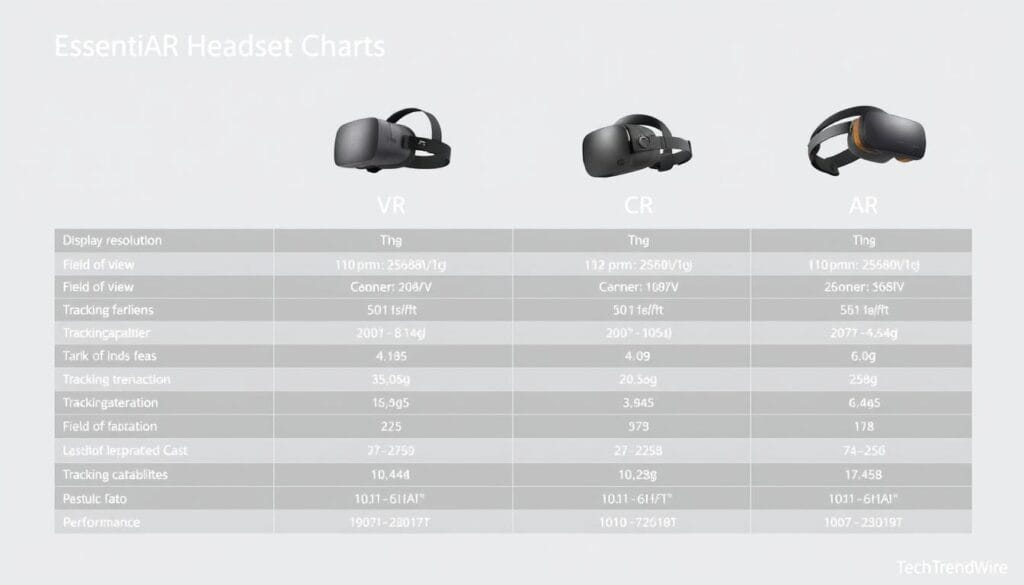
Display Resolution and Field of View
- Virtual reality buying tips begin with resolution. Higher pixels per eye mean clearer images. Aim for at least 1600×1600 per eye for a good experience.
- Field of view (FOV) over 100° helps avoid “tunnel vision.” This makes the experience feel more real. For example, the Meta Quest 3 has a 110° field of view.
Processing Power and Performance
For augmented reality purchase advice, look for chipsets like Qualcomm Snapdragon XR2 or Apple’s M2 chip. These handle complex graphics smoothly.
- RAM is crucial in AR: 6GB+ ensures apps like Microsoft HoloLens 2 run smoothly.
- Be cautious of “paper specs” that don’t match real-world performance. Look for reviews of games like Half-Life: Alyx on headsets.
Tracking Systems and Controllers
“Tracking precision isn’t just about accuracy—it’s about reliability,” says VR engineer Lena Torres. “6DOF systems let you move freely, while inside-out cameras eliminate sensors cluttering your space.”
- Choose hand-tracking features in newer models like the PICO 5 to reduce controller dependency.
- Check latency specs: under 20ms input lag prevents motion sickness in VR.
Comfort and Ergonomics
Weight distribution is key—headsets under 500g (like the Valve Index) are easier to wear for long periods. Adjustable straps and face pads are more important than processor speed for comfort.
Remember: virtual reality buying tips should focus on what you need. A racing game needs high refresh rates; a social VR app? Focus on social tracking features.
Top Virtual Reality Headsets Worth Your Investment
Choosing the right top virtual reality devices means looking at specs and what you need. Our vr headset comparison guide shows top picks that offer great performance, comfort, and support for different systems. Think about what you want before you buy.
“The Quest 3’s 120Hz display reduces eye strain during long sessions.”
Meta Quest 3 leads with its powerful chip and lots of storage, perfect for gamers and creators. It costs $499.99 and comes with a $50 Amazon credit. The best vr/ar products review loves its apps and social features. The Quest 3S is cheaper but has less resolution and storage.
- HTC Vive Focus 3: Offers top-notch tracking and durability for work.
- PlayStation VR2: Has exclusive games like Horizon Call of the Mountain for PlayStation fans.
- Pico 4 Pro: Features eye-tracking and a comfy design for long use.
Consider more than just specs. Does the headset’s app store keep growing? Is setup easy? The Quest 3’s ecosystem adds new features every month. Check if controllers or accessories cost extra. Comfort is key; look for adjustable headbands and IPD.
Not sure what to choose? Our vr headset comparison guide details hidden costs, developer plans, and battery life. Your best headset depends on what matters most to you: power, price, or platform.
Leading Augmented Reality Platforms and Devices
Augmented reality (AR) lets you explore new things without a headset. Just use your smartphone. AR shopping tips show how phones can run cool apps with ARKit and ARCore. These apps turn your phone into a tool for 3D objects and interactive fun.
Apps like IKEA Place and Snapchat filters show how easy it is to get into AR. They make best vr/ar products review options simple and fun.
Smartphone-Based AR Options
Smartphones are a great starting point for AR. New Apple and Samsung phones have LiDAR sensors for depth. Choose apps that understand your environment well.
Augmented reality purchase advice suggests picking devices with strong software. Apple’s Vision Pro is a good example for the future.
- iPhone 15 Pro: ARKit 6 supports object occlusion and realistic lighting
- Google Pixel 8: ARCore 2.0 enables shared AR experiences with friends
Standalone AR Headsets and Glasses
| Device | Field of View | Battery Life |
|---|---|---|
| Microsoft HoloLens 2 | 52° | 3+ hours |
| Magic Leap 2 | 56° | 4 hours |
| Nreal Air | 50° | 3 hours |
These devices are designed for both looks and function. Nreal Air is small and portable, while Magic Leap 2 is tough for work. Make sure they fit your needs before buying.
Enterprise-Grade AR Solutions
AR is great for work, like training and fixing things. Boeing uses Microsoft HoloLens 2 to help assemble planes, cutting errors by 30%. When looking at best vr/ar products review for work, think about how they scale and fit with your tools.
AR is more than a trend; it’s a way to make work more efficient.
Accessories That Enhance Your VR/AR Experience
Choosing the right virtual reality gear suggestions can make your VR/AR setup unforgettable. Let’s look at must-have accessories that solve real-world problems and boost your tech’s potential.
Motion Controllers and Haptic Feedback Devices
Standard controllers are a good start, but ar/vr shopping recommendations for special gear can change the game. Gamers will love haptic gloves like ULTRA or VR steering wheels from Logitech G. These add realism to racing games.
For social VR, full-body trackers like Intellicat’s VEST make fitness routines feel real. Haptic feedback devices, like HaptX gloves, make virtual objects feel real.
Tracking Stations and Room Setup Essentials
Improve tracking with add-ons like Valve Index base stations for bigger play areas. Ceiling mounts from VR Station keep trackers steady, reducing drift. Cable management kits from 3M keep cables tidy, preventing tripping hazards.
Wireless adapters like Lenovo ThinkReality’s dongles get rid of cord strain. This is key for safe gaming.
Comfort Modifications and Extended Battery Solutions
Boost comfort with aftermarket face cushions from Respa or adjustable head straps by Triband. For longer battery life, Anker power banks add 3–5 hours to wireless headset use. Apple’s Charge Limit feature on newer iPhones also helps.
Prescription lens kits from Nikon ensure clear vision without glasses. Smart vr/ar buying guides focus on solving your specific needs. Start with basics like cooling pads or neck straps before getting premium upgrades. Your setup’s potential is in the details that make tech work seamlessly for you.
Common Purchasing Mistakes to Avoid
Buying VR/AR tech without doing your homework can be a letdown. Virtual reality buying tips and AR shopping tips often point out common mistakes. Let’s look at the most common errors to help you avoid buyer’s remorse.
- Ignoring field of view: High resolution is important, but a narrow field of view can ruin the experience. Make sure to check the specs beyond just the pixel count.
- Skipping space checks: Room-scale VR needs at least 3×3 meters of space. Measure your room before you buy.
- Buying for future updates: Don’t buy devices that promise features that aren’t available yet. Focus on what works now, not what might work later.
- Overlooking brightness: AR shopping tips remind us to test AR displays outdoors. If they’re too dim, they won’t work outside.
- Forgetting total cost: Headsets often need extra controllers, trackers, or subscriptions. Make sure to budget for these extras.
| Mistake | Fix with VR/AR buying guides |
|---|---|
| Choosing the latest model blindly | Compare older models for better value-to-price ratios |
| Neglecting software library | Verify apps and games available on your chosen platform |
| Ignoring manufacturer support | Check company update history to avoid abandoned hardware |
Don’t let these mistakes ruin your purchase. VR/AR buying guides stress the importance of practical research. Try out devices in stores, read reviews, and talk to communities. By avoiding these common pitfalls, you can find tech that meets your needs and budget.
Compatibility Considerations: Ensuring Your System Meets Requirements
Before you buy, make sure your system is compatible. Our vr headset comparison guide shows that even the best top virtual reality devices can fail if your system isn’t up to par. Here are the key things to check to avoid any issues after you buy.
PC Requirements for Premium VR
- Graphics cards like NVIDIA RTX 3080 or AMD Radeon RX 6800 XT ensure smooth performance.
- Windows 10/11 and at least an Intel i5-9th Gen or AMD Ryzen 5 processor are must-haves.
- Check ports: HDMI 2.1 or DisplayPort 1.4 required for headsets like the Meta Quest Pro or HTC Vive.
Mobile Device Compatibility for AR Applications
AR apps need modern hardware. iPhones need iOS 16+ and LiDAR sensors (e.g., iPhone 12 Pro models). Android devices require ARCore support and 64-bit processors. Avoid using devices older than 2020 to prevent lag.
Gaming Console Integration Options
PS5 users get full support for top virtual reality devices like the PlayStation VR2, while Xbox Series X/S owners can stream PC VR games via cloud features. Nintendo Switch lacks native VR, but there are workarounds using third-party accessories.
Make sure your Bluetooth version, USB-C bandwidth, and Wi-Fi 6 support are up to date. Use tools like SteamVR’s hardware check or Apple’s ARKit readiness tool for easy checks. Choose devices with updates planned for 2024-2025. This way, you won’t end up with a headset that can’t connect to your router!
Conclusion: Making an Informed VR/AR Investment
Choosing the right VR/AR solution starts with knowing your goals. The best vr/ar products review should match your needs. Whether you’re into gaming, productivity, or exploration, there’s something for everyone.
Virtual reality gear suggestions like Meta’s Oculus Quest 2 are reliable for immersive experiences. Analysts like Wedbush and UBS have raised price targets for Meta. This shows they believe in the tech’s growth.
For augmented reality, platforms like Apple’s ARKit or Microsoft HoloLens offer tailored solutions. Look for devices with strong content libraries and community support. Entry-level models like the Oculus Quest 2 let you test VR without breaking the bank.
Always check software compatibility and hardware specs to avoid future frustrations. Enterprise tools like Microsoft’s HoloLens 2 are perfect for professional uses.
The VR/AR market changes quickly. Follow reviews and join forums like Reddit’s r/Vive or r/AR. Also, track updates from brands. Meta’s recent financials show their commitment to innovation.
Let your choices align with today’s needs while keeping an eye on future trends. With the right tools and research, VR/AR becomes more than gear—it’s a gateway to new possibilities.