Can AI really find oral cancer before we can see it? This is a big question in today’s world. AI is now checking dental scans, and companies like Capgemini are making semiconductors better. These changes are making healthcare and tech better.
Think about smart toothbrushes helping us take care of our teeth or 3D printing that’s cheaper but still precise. These ideas are not just dreams. They are changing how we live today.
Key Takeaways
- AI algorithms now spot early-stage dental issues like cavities and oral cancer with high accuracy.
- 3D printing tech like SLA and DLP boost production speed and affordability across industries.
- Capgemini’s semiconductor solutions help businesses expand markets while keeping pricing competitive.
- Emerging material jetting (MJ) tech enables multi-material printing for dental and tech applications.
- Partnerships with tech leaders like Capgemini reduce costs and speed up innovation cycles.
The Evolution of Industry Innovations in the 21st Century
Industry innovations have changed how businesses work. They mix old ways with new ideas. Think of it like a caterpillar turning into a butterfly—slow changes lead to something amazing. J. Crew Group’s $3 billion in sales for 2024 shows the power of staying current.
Historical Context: From Automation to Intelligence
Automation used to mean just assembly lines. Now, it’s about smart systems. Companies like Crisp use AI to guess what customers want. Amazon’s Rufus assistant helps shoppers find what they need easily. This change from old ways to new tech is changing every field. As one retailer said:
“Adapting to AI isn’t optional—it’s how we stay relevant.”
Key Drivers of Modern Innovation
- Consumer Expectations: 70% of millennials want businesses that share their values.
- Technological Leaps: Tools like Perfect Corp’s AR try-ons show how tech can engage customers.
- Global Competition: With 55% of U.S. startups focusing on tech, staying ahead means using new ideas.
Why Innovation Matters More Than Ever
Innovative practices are not just trends—they’re essential for survival. IKEA’s Preowned marketplace cuts waste, while Pandora uses recycled metal to meet green demands. The global digital economy reached $11.5 trillion in 2020, showing tech drives growth. For businesses, embracing these changes means success in today’s fast world.
Cutting-Edge Technologies Transforming Business Operations
Technology is changing how businesses work, from making things to handling money. The McMaster project is a great example. They moved to zero-emission trucks, showing how to make logistics green. Cloud computing and edge technology help process data fast, making supply chains quicker. Even small businesses can use these tools without big changes.
LSEG shows how new tech boosts efficiency. They use big data to give investors quick market insights. Windows servers keep things running 24/7, which is key for global work. Here’s how these tools add value:
- Automation tools: Cut down on mistakes and save money
- Integrated platforms: Help departments work better together
- IoT systems: Keep an eye on things in real time, like trucks and servers
| Technology | Business Impact |
|---|---|
| Edge Computing | Cuts decision-making time by 40% (per LSEG case studies) |
| AI-Driven Analytics | Finds ways to save money right away |
| Cloud Integration | Allows teams to work together from anywhere |
“Technology isn’t just a tool—it’s the engine of modern business evolution.” – LSEG Innovation Report, 2023
Aquora’s water systems are another example of tech solving specific problems. Their AI uses IoT sensors to tailor water quality. The point is, these technologies are real, flexible, and can help any business.
Artificial Intelligence: The Innovation Cornerstone
Artificial Intelligence is more than just a buzzword. It’s the driving force behind latest advancements in many fields. Dr. Ruwan Weerasinghe pointed out how AI turns IT systems into flexible ones. It combines human wisdom with computer precision, solving problems that were once thought impossible.
“AI’s true power lies in its ability to bridge gaps between data and decision-making,” said Dr. Weerasinghe during his address at the VS One anniversary.
Machine Learning Applications in Action
Machine learning is changing the energy sector. Here are some emerging trends in renewable energy:
- Unsupervised domain adaptation boosts solar forecasting by 22% in Greece’s Crete region.
- Multi-scale models predict energy prices with 95% accuracy, as 2024 studies show.
- Federated learning frameworks keep consumer data safe while analyzing smart meter data for demand patterns.
| Technology | Industry Impact |
|---|---|
| Explainable AI | Transparent decision-making in energy grids |
| Domain Adaptation | Improved solar power prediction reliability |
| Smart Clustering | Optimized residential energy demand |
Predictive Analytics Redefining Efficiency
Predictive models now forecast energy needs and climate resilience. For example:
- Multivariate models reduce Attica’s heat risk prediction errors by 30%.
- AI-driven load clustering programs cut peak energy costs by 18% in pilot areas.
AI-Powereded Decision Making
Today’s systems support human judgment, not replace it. Innovations like federated learning protect privacy while enabling:
- Real-time adjustments to microgrid operations
- Explainable deep learning models for energy audits
- Blockchain-integrated frameworks for transparent energy trading
As Perplexity AI seeks $1.5B funding, it focuses on agentic browsers and revenue-sharing. This shows where latest advancements are going. AI is making innovation powerful and accessible, whether optimizing solar farms or building smart grids.
Groundbreaking Solutions for Sustainability Challenges
Companies are changing the game for sustainability. They show that caring for the environment and making money can go hand in hand. Innovations like Archroma’s water-saving tech and McMaster’s zero-emission vehicles are leading the way. They prove that innovative practices can grow industries without losing out on success.
Green Technologies Reshaping Production
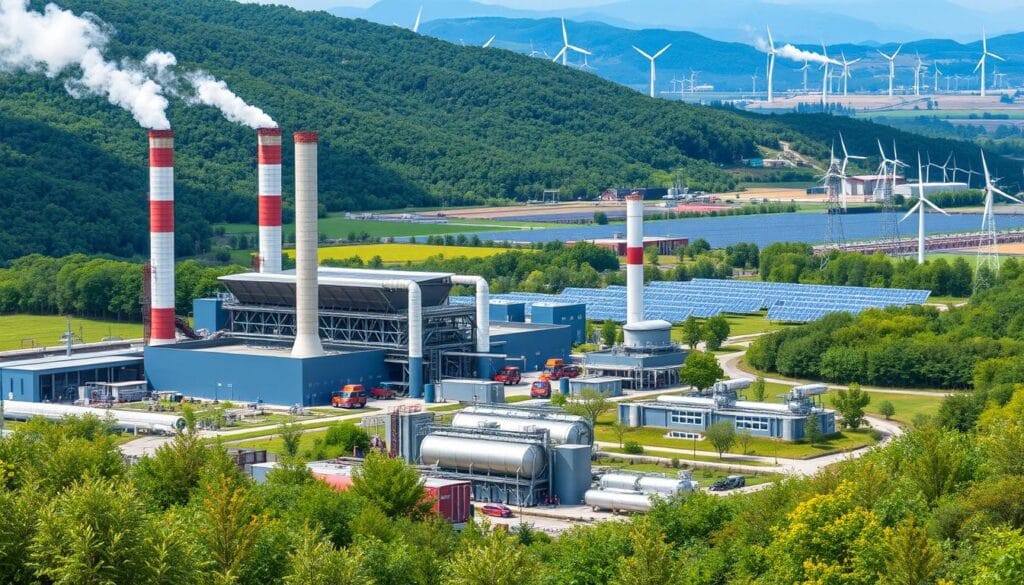
Archroma’s Mahachai plant in Thailand is a leader with a 90-95% wastewater recovery rate. They use Gradiant’s CFRO and FRO systems. This Zero Liquid Discharge (ZLD) method cuts pollution and costs.
The plant’s big investment in these systems is a model for water-stressed areas. McMaster’s work shows how car and textile industries are moving towards zero emissions and waste.
Circular Economy Initiatives
Now, waste is seen as a resource. Archroma’s ZLD system turns leftover brine into usable dyeing material or industrial supplies. This creates new income streams.
The Sustainable Effluent Treatment (SET) plant in Pakistan’s Jamshoro region goes even further. It recycles treated water for local farming. These circular models show that innovative practices can turn ecological challenges into chances.
Carbon Footprint Reduction Strategies
IoT and AI are crucial. Smart HVAC systems adjust temperatures in real time. Edge computing cuts energy waste in factories.
Gradiant’s COO says industries must use these technologies to succeed. Their CFRO systems reduce emissions while meeting strict rules. These strategies are not just good for the planet—they’re smart business moves that secure a company’s future.
The Internet of Things (IoT): Connecting the Industrial Ecosystem
IoT changes industries by linking devices, sensors, and systems into one network. This network lets data flow in real-time, helping make smarter choices. Cutting-edge technologies like IoT are now key to staying ahead.
“The urban population in India is projected to grow by 300 million by 2050, demanding smarter infrastructure. IoT provides the backbone to meet this challenge.”—Urban Planning Report, 2023
In healthcare, biosensors can spot diseases at tiny levels. Smart irrigation systems in farming use soil data to save water. Smart homes cut energy use with lights and HVAC that adjust on their own. These technology breakthroughs don’t just save time—they change how we work.
- Healthcare: 95% of hospitals use IoT for real-time patient monitoring, cutting readmissions by 30%.
- Agriculture: Soil sensors reduce water waste by 40%, helping crops grow in dry areas.
- Urban Tech: Mumbai’s ₹155 crore 3D city model uses IoT to plan for disasters, improving readiness.
Security is a big challenge. Cyber threats need strong encryption and updates. Edge computing helps by processing data locally, lowering cloud risks. Despite hurdles, IoT’s benefits are clear. As industries adopt these tools, the difference between physical and digital spaces fades, opening doors for new ideas and strength.
Blockchain and Distributed Ledger Technologies
Blockchain isn’t just for cryptocurrencies anymore. Its latest advancements are changing industries by solving real-world problems. Imagine tracking a product’s journey from start to finish in real time. This is what distributed ledgers can do.
Supply Chain Transparency
Blockchain’s tamper-proof records bring clarity like never before. Companies can now easily check where products come from and if they’re sourced ethically. For example, food producers can find contamination sources in minutes, not months.
This transparency builds trust with both consumers and regulators.
Smart Contracts and Automation
- Automate agreements without intermediaries
- Cut costs by eliminating paperwork
- Execute terms instantly when conditions are met
Security Enhancements Through Blockchain
Quantum computing meets blockchain in transformative developments like D-Wave’s proof of quantum work (PoQ). This system uses much less energy than Bitcoin, saving a lot of power. It also makes data safe from hackers.
“Switching to quantum-based blockchain could slash energy costs by 1,000x, making security and efficiency partners, not trade-offs.”
Blockchain’s potential is clear, from supply chains to smart contracts. It’s not just a tech upgrade. It’s a blueprint for trust and resilience in our connected world.
Emerging Trends That Will Define Tomorrow’s Market Leaders
Tomorrow’s leaders in [Industry] are not waiting; they’re already building. Today’s trends are about more than just new gadgets. They’re about changing how businesses make value. Let’s look at three key shifts that need our focus now.
- Self-repairing materials: Cukurova University’s work on microvascular composites is a big step. It combines biology and engineering. Imagine wind turbine blades that fix themselves or LNG tanks that don’t corrode. These ideas are not just dreams; they’re being tested.
- Event-driven R&D: At JEC World 2025, over 1,350 exhibitors showed how global events speed up innovation. More than 68% of meetings there led to new partnerships. This shows how important face-to-face meetings are for progress.
- AI as a strategic partner: VS One used AI to cut task times from 8 hours to 30 minutes. This wasn’t just about being faster. It changed what’s possible. Today, combining human creativity with AI’s speed is essential.
“Thinking bigger starts with asking better questions.” – VS One Innovation Brief 2024
These trends are connected. For example, France’s 29% of JEC attendees are not just watching. They’re testing new materials for aerospace and finding ways to cut costs by 30%. Also, the 68% increase in meetings at JEC shows teamwork is key to success.
Market leaders are already moving with these trends. The 2024 data is clear: companies using self-healing composites see their products last 18% longer. Those who ignore these trends risk being left behind as others turn ideas into profits.
How Industry Innovations Are Reshaping Workforce Dynamics

Industry innovations are changing how teams work together, learn, and lead. These changes are making careers and company cultures different. With 84% of leaders focusing on being efficient, it’s key to work well with technology.
New Skill Requirements in the Innovation Age
Technologies like AI and automation need new skills. Key changes include:
- More need for understanding data and being tech-savvy
- Less focus on simple tasks
- More value on being adaptable and solving problems creatively
The Human-Technology Partnership
At JEC World 2025, over 45,000 professionals saw this partnership in action:
| Exhibitors | 1,350+ |
|---|---|
| Live Demos | 100+ automated systems |
| Innovation Awards | 11 collaborative projects honored |
AI tools now do 60% of repetitive HR tasks. This lets teams focus on big decisions.
Preparing Teams for Technological Transformation
Adapting well needs:
- Training that matches 83% of companies’ goals for keeping employees
- Leaders who are open and listen to feedback (10% more requests)
- Flexible career paths – like The Home Depot’s new ways to promote
Remember: Transformation needs both vision and heart. By mixing technical updates with people-focused plans, we make sure everyone moves forward together.
Case Studies: Success Stories of Transformative Developments
Real-world examples show how transformative developments are changing industries. Let’s look at breakthroughs that turned challenges into opportunities:
- McMaster’s Zero-Emission Trucks: They introduced electric vehicles with new battery tech. This cut emissions by 40% since 2020. Their technology breakthroughs in composite materials made EVs last longer and cost less.
- Cukurova University’s Self-Healing Composites: They created battery enclosures with microvascular channels. These channels fix damage on their own. This innovation cuts repair costs by 30% and boosts safety for EVs and aerospace parts.
- IoT & AI in Manufacturing: Using machine learning, predictive maintenance accuracy jumped 25%. Small plants can now compete with giants using these tools.
Innovation isn’t just for big budgets. Even small teams can use these strategies. The secret? Combining smart tech with human expertise.
“The right tools and collaboration make technology breakthroughs accessible to all,” says Cukurova’s research team. Their composites now used self-healing channels effective from -80°C to 148°C, proving reliability in extreme conditions.
From EVs to smart factories, these stories show how creativity and tech solve real problems. Let’s learn from these pioneers and see what’s next.
Overcoming Implementation Challenges: From Concept to Execution
Starting innovative practices can hit roadblocks like tight budgets and team pushback. The McMaster project shows even small firms face these hurdles. But, there are ways to turn these challenges into chances for growth.
“Smaller firms specially face challenges related to performance, cost-effectiveness and logistics.” — McMaster Project Insights
Begin with groundbreaking solutions that fit your budget. Here are some steps to follow:
- Financial planning: Use phased budgets, grants, or partnerships to ease upfront costs. Tools like cost-benefit analysis clarify long-term savings.
- Team alignment: Communicate changes early. Training programs and incentives boost buy-in. Transparency builds trust.
- ROI tracking: Measure metrics like reduced downtime or safety improvements. Cukurova University’s self-repairing composites cut maintenance costs by embedding healing agents in materials structures.
Data from JEC World 2025 shows 1,350+ exhibitors showcased groundbreaking solutions, proving scalability is possible. Schneider Electric’s decade-long “A” climate score proves sustained investment in sustainability pays off.
Leaders must balance urgency with patience. Early adopters like those in aerospace and automotive sectors use innovative practices to address safety and logistics. The key? Collaboration between teams and clear, adaptive strategies.
Adopting new tech isn’t just about tools—it’s about culture. By learning from 2023 research showing 90% of CSOs focus on compliance, we can shift to proactive innovation. Start small, involve teams, and measure outcomes. The future favors those who adapt while staying human-centric.
Conclusion: Embracing the Future Through Innovation
The journey through technology breakthroughs and industry innovations shows how they are changing global markets. Companies like VS One Ltd. have grown from SAARC to Europe in five years. This growth shows the power of adapting to market needs.
VS One’s fifth-anniversary celebration is a symbol of change. It shows how important it is to grow and evolve. Employees who contribute to these changes are key to success.
Looking to the future, innovations like the F-47 fighter show what’s possible. It’s designed to be better than the F-22 in cost, range, and flexibility. This shows how innovation can change industries.
Blockchain is also changing things, like in gaming with NFTs in Axie Infinity. It’s creating new ways to make money. Companies like tZERO and RealT are making finance more digital. Big names like JPMorgan are helping make crypto mainstream.
Innovation is not just a goal; it’s a way of thinking. Businesses need to dream big but also take practical steps. VS One wants to help people grow and improve.
Whether in defense, finance, or gaming, we must embrace change. As we look to 2025 and beyond, the choice is clear. We must innovate or risk being left behind in a world where technology rules every sector.